The servo · Inside the case
Meet the servo.
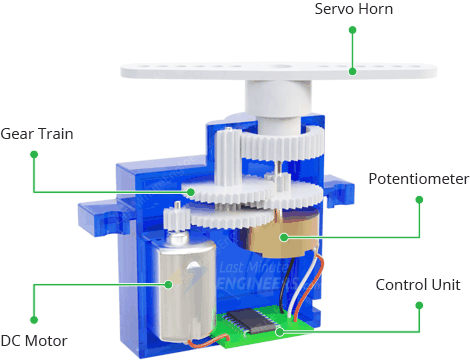
All those parts. One small package.
We send the command.
We send a PWM control signal to the servo.
The pulse width tells it the position we want.
Inside, a small control chip compares that target with the actual position and controls the motor.
Think of it as a tiny “Arduino-like brain.” The pseudocode explains its job; a basic analog servo can do that job with circuitry rather than stored code.
The motor turns the gears.
The motor spins. The gears reduce the speed and increase the available turning force.
The final gear turns the output shaft and servo horn.
That output shaft also turns the potentiometer.
The pot reports back.
As the shaft turns, the pot’s voltage changes.
That reading goes back to the control chip.
The chip checks the position and controls the motor:
move forward, move backward, or stop correcting.
It keeps checking — so it can correct the position again.
Command → movement → feedback.